
When a Fabric Feels Right
How do you know whether a fabric is truly high quality? A high Martindale count can tell us how a fabric performs under abrasion. It cannot tell us how it feels, how it ages or whether it belongs in your home.
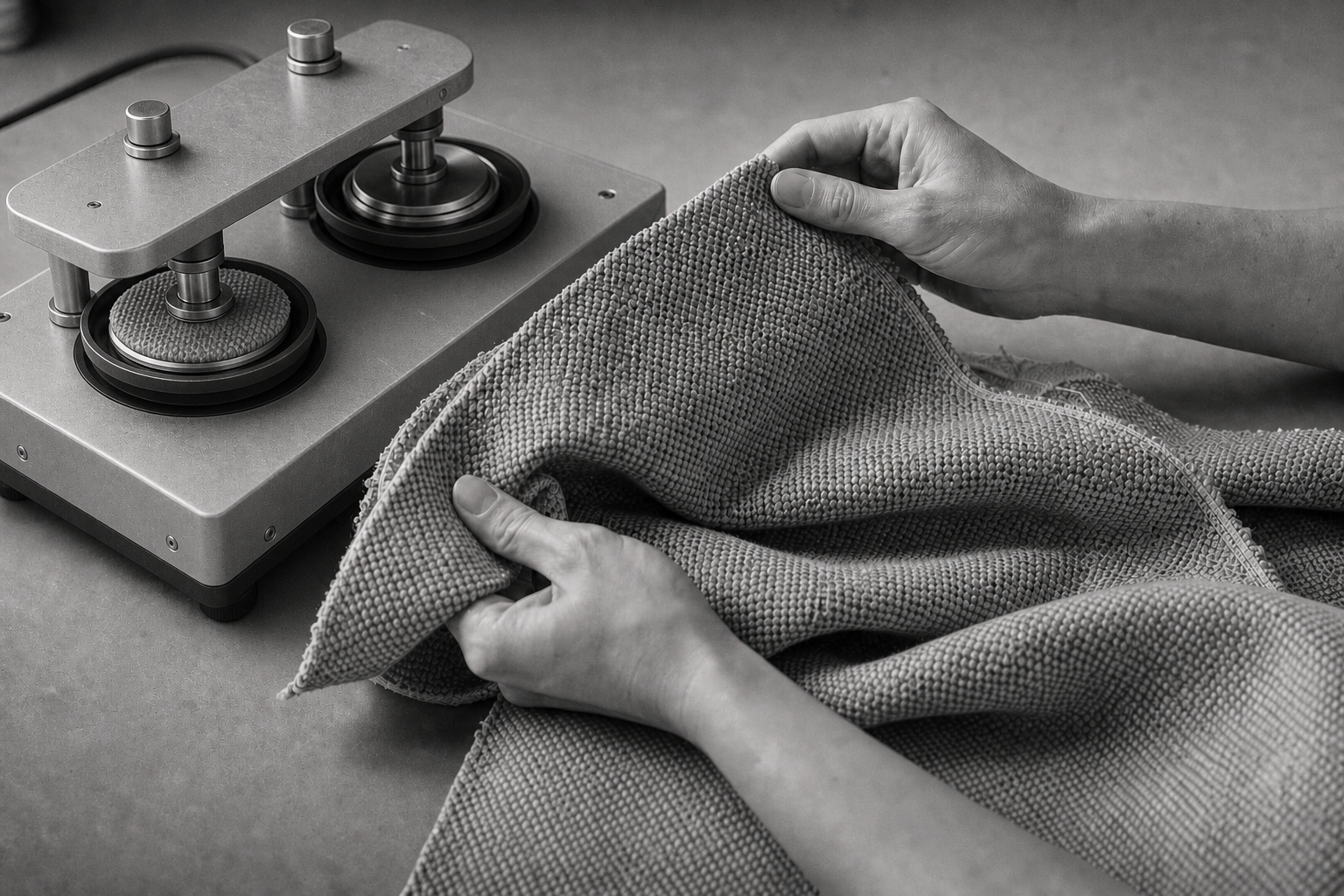
A fabric label offers numbers: composition, width, weight and Martindale count.
Quality reveals itself differently—in the way a fabric falls, responds to touch and changes as light moves across it.
A specification describes how an upholstery fabric behaved in a laboratory. It cannot tell you whether you will enjoy living with it.
Linen at a window lives differently from wool on a dining chair, and a sofa shared with children asks for something else again.
The question is not whether a fabric is good, but whether it is right for the life around it.
Begin with the life around it
Before looking at a number, imagine the fabric in use.
Will it be sat on every evening or touched only occasionally? Will sunlight move across it for hours? Must it recover from a glass of wine, a wet swimsuit or the particular enthusiasm of a small child?
A beautiful fabric in the wrong place becomes a source of anxiety; a highly durable one chosen without regard for touch survives everything and brings little pleasure.
Dining chairs meet friction along their edges. Sofas carry weight across broad surfaces. Curtains live with sunlight and gravity. Cushions are handled and compressed.
Suitability begins with use.
The number everyone notices
When choosing upholstery fabric, one figure receives more attention than the rest: the Martindale count.
The test measures resistance to abrasion. A sample is rubbed under controlled conditions until a defined level of wear is reached.
The result is useful. It distinguishes a decorative textile from one developed for repeated upholstery use, and keeps a delicate fabric off a family sofa.
But the Martindale count is not a universal score for quality. A very high result does not make a fabric more beautiful, more comfortable or more appropriate for a particular home.
Laboratory abrasion is orderly. Daily life is not.
What the number cannot tell you
A fabric can resist abrasion and still pill, fade in a bright room, stretch at the seams, hold stains or feel unpleasant against bare skin.
Other measures matter. Pilling tests count the small balls of fibre that form through use. Lightfastness shows how well a colour resists fading. Colourfastness considers whether dye transfers through rubbing or moisture.
A pale fabric that performs beautifully but needs specialist care after every mark feels natural in one home and exhausting in another.
Quality is not one exceptional number. It is the relationship between performance, beauty and the demands of the room.
Composition is only the beginning
Linen can feel crisp or relaxed. Wool may be softly felted, densely woven or light enough to drape. Cotton runs from dry and structured to almost velvety. Synthetics bring resilience, colour stability and ease of maintenance.
Natural does not automatically mean better; synthetic does not automatically mean inferior. A thoughtful blend exists because different fibres do different work—one for softness, one for strength, one for recovery after compression.
Construction matters as much. A loose weave can be expressive but vulnerable to snagging; a dense weave offers stability. A raised pile shifts as it is brushed and catches light differently through the day. Bouclé disguises irregularities while inviting jewellery or claws.
Turn the sample over. Bend it. Rub the surface between your fingers. A fabric starts to explain itself when it is handled.

The hand of the fabric
Designers speak about the hand of a textile: the way it feels, falls, folds and responds to touch. This cannot be understood fully from a photograph.
A fabric may look soft on a screen and feel unexpectedly coarse. A simple wool can reveal extraordinary depth in natural light. Linen that appears creased in a small sample may fall beautifully across a full curtain.
Touch is not a decorative extra. The fabric on a sofa meets the body every day, beneath the hand and against the back of a leg. Its temperature, texture and softness become part of how the room is experienced.
Technical suitability allows a fabric to perform. Its hand gives someone a reason to love living with it.
Understanding what belongs
A designer’s role is not simply to present fabrics or compare specifications. It is to understand the life the material will enter: what a person notices, how formally or freely they use their home and which signs of age they find beautiful.
Technical knowledge helps interpret the information. Understanding decides what belongs.
Scale and light matter too. A strong texture becomes calmer across a large sofa; a subtle weave gains unexpected presence covering a wall. Morning light can reveal warmth that fades by evening.
The sample should sit beside the stone, timber, flooring and wall finish it will meet. A fabric is never chosen alone; it becomes part of a composition, and part of someone’s daily life.
A fabric is right when its beauty and performance belong to the life around it.
— LANGE
The right fabric, not the toughest one
There is reassurance in technical data. The Martindale count, composition and performance tests help rule out fabrics unsuitable for what will be asked of them. They support good judgement; they do not replace it.
Choosing well means considering use, construction, touch, light, maintenance and time together. The most durable option may not be the most appropriate, and the most beautiful one should not make daily life feel fragile.
A home should be lived in without constant negotiation. The right fabric allows that life to happen: it performs where it must, softens where it should and feels natural to the person living with it.
Eventually, no one thinks about its specification at all.
They simply know that it feels right.